After the Storm
What 8th Graders Can Learn From Katrina

Designed by James Cardo, Teacher at The Harbor School, Vashon, WA, USA
Read excerpts from students after watching After the Storm
- Writing exercise after class has watched the film AFTER THE STORM together.
- Give a brief personality description of any two of the people from the film. Include some impressions of each and ideas about their roles in the group.
- For those two people OR for two of the other people, detail the challenges that they did face or perhaps still are facing.
- Since these are kids close to your age, can you explain how (even though you didn't survive a hurricane. . .) some of their problems might be similar to things that you have faced yourself? If you can't find similarities, can you explain what it is about your life that does not put you in such positions?
- Why is it hard for some people to ask for help, even when it's obvious to most anyone that some assistance is needed?
- Shut your eyes and imagine that you get to visit any place you want in New Orleans for 2 weeks. Write exactly where you would go, who you would want to meet, what you would ask people, and what you would hope to accomplish (other than "eat great food and hear great music").
- Give a brief personality description of any two of the people from the film. Include some impressions of each and ideas about their roles in the group.
- Thematic Unit: New Orleans
Initial Drafting: James Cardo
The Harbor School
www.harborschool.org
- Overview:
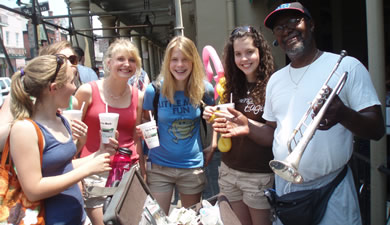
This unit is a multi-disciplinary exploration of New Orleans, its geography and culture, and the aftermath of the flooding of 2005. Designed for an 8th grade class, it weaves together Social Studies, Science, and English along with brief interludes in Math and Spanish. The conclusion of the unit is a twelve day trip to New Orleans. That trip includes exploration of the city's sites, interaction with the people, exploration of the bayous and waterways, and multiple days of service learning in both the neighborhoods and the wetlands.
Purpose: The purpose of this approach is to put the lessons into a context, to create a web of information that the students can use to approach realistically the City of New Orleans and its issues. The students will be motivated to solve problems holistically and collaboratively. When the unit and the trip have been completed, the students will present their findings and knowledge to others via a variety of outlets, thus concluding their learning by sharing it with their community.
Theme: Because of its history, cultural contributions, and geography, New Orleans, Louisiana occupies an important and unique role in the fabric of American culture. The erosion of the wetlands in the Mississippi Delta threatens the city, and the flooding from hurricanes in 2005 clearly showed the imminent danger. This unit will explore the rich and varied background of the city, the state of the wetlands that surround it, and the response of the U.S. Government in the wake of the disaster.
- Travel Study
Objectives:- To connect with and come to understand a portion of America that is substantially different than that of the students' experience.
- To help others in a time of need and then to inspire others to do the same through our example
- To explore the New Orleans as a city, a natural habitat, a cultural phenomenon, and a disaster area
- To further strengthen the bonds between our 8th grade class
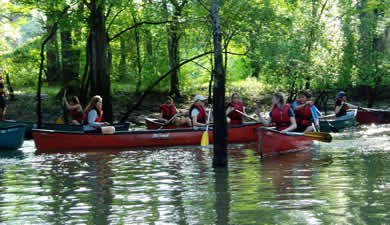
- Five day backcountry canoe trip down the Black Creek in Mississippi.
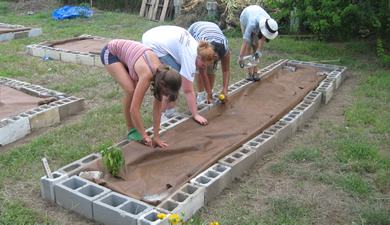
- Service Volunteering with Hands-On New Orleans, which helps with housing and construction
- Service Volunteering with Bayou Relief, which works to mitigate wetlands damage
- Service Volunteering with the North Rampart Community Center, the site of the film After the Storm
- Attend a performance at Preservation Hall
- Explore the French Quarter
- Sample a wide variety of New Orleans cuisine
- View the IMAX film Hurricane on the Bayou
- Interact with the people of New Orleans
- Identify and catalog flora and fauna while in the wetlands and rivers
- Strengthen the community and bonds of the 8th grade class by living, working, and traveling together
- Community Lunch gathering for the whole school featuring Louisiana Cuisine
- Performance of regional music, both recordings and possibly live musicians (The Preservation Hall Jazz Band plays in Seattle in April.)
- King Cake ceremony to kick of the Mardi Gras season
- Hanging of New Orleans art, photographs, and photos from previous trips
- Mock debate between environmentalists and corporations about the causes of erosion in southern Louisiana.
- Primarily there is a full presentation of the trip and what the students learned on and before it. It is given to all of the school's students, plus the parents and any interested community members. There will be photos, skits, journal readings, charts, flora & fauna samples, etc.
- Some student writing will be submitted to the local newspaper for publication. Other pieces will be published on the school's website.
- Social Studies:
Objectives:- Understand the facts about the flooding of 2005
- Familiarize students with maps of the city and region
- Research the demographics of the area both currently and historically
- Note the major historical events in New Orleans' history
- Understand major aspects of the culture of the city
- Analyze the FEMA and state response to the flooding
- Assess the state of the city's recovery as of 2010
- Archived news stories from 2005. Times-Picayune and national papers & magazines
- Archived news footage
- Encyclopedic materials, US History texts
- Electronic and paper maps of the city and of Louisiana and the Gulf Coast
- Demographic data from the census and other sources
- Editorials and commentary on the disaster response. Congressional hearing transcripts.
- Clips from Hilla Medalia's After the Storm, Spike Lee's When the Levees Broke and other films
- First person accounts from the students during and after their trip (writings and recordings)
- 2D map exploration and navigation
- Poster presentations on various aspects of historical information
- News anchor re-enactment of interview and reporting
- Class lecture and note-taking
- Commentary and reader-response to the film viewing
- Round table discussions about the students' reading and research
- Specific questions to be generated by the classroom teacher
- Specific teacher and peer feedback on the various individual pieces of the unit
- Self-reflecting student feedback in an End-of-Unit update
- English:
Objectives:
- Explore the culture of New Orleans
- Read some of the literature of the city
- Listen to the music of the region (jazz, zydeco, blues)
- Engage with first person accounts of the New Orleans flooding
- Record the students' own thoughts and reactions to all of these through journals, brief essays, and poems.
- Collections of Cajun and Creole folktales from the King County Library System
- Excerpts from noted New Orleans based novels: Confederacy of Dunces by Toole, New Orleans, Mon Amour by Codrescu, The Feast of All Saints, by Rice, Life on the Mississippi by Twain, The Moviegoer by Walker Percy
- Film clips from the above Social Studies films (Medalia, Lee) plus A Streetcar Named Desire
- Graphic Novel: Josh Neufield's A.D.: New Orleans After the Deluge
- Various Music: Armstrong, Neville Brothers, The Meters, Cajun & Zydeco collections, Tab Benoit, Harry Connick, Jr., etc.
- Exploration of the dialects of Louisiana
- Student creation of Louisiana folktales
- Creation of interview questions to use while in New Orleans
- Collages representing various aspects of the literature the students read
- Journal reactions to the films and music
- Public readings or performances of the literature
- These questions will be based on the literature selections read, viewed, and heard. Some of the discussion will be round table. Some will be led by students and/or the teacher. Some responses will be written.
- Specific teacher and peer feedback on the various individual pieces of the unit
- Self-reflecting student feedback in an End-of-Unit update
- Spanish
Objectives:- Explore the Spanish and Hispanic history in the region and its effect on the current culture of New Orleans
- Research the current demographics of the Hispanic population in New Orleans and Louisiana
- Learn some vocabulary and phrases that might be helpful while traveling
- Web based information and research about the history of the region
- First person accounts in Spanish of that history and current events
- Reading and translation of various accounts
- Timeline of Spanish influence in New Orleans
- Examination of the musical influences of Spain on the music of New Orleans
- Conversational practice
- General discussion about the reasons for Spanish acquisition and loss of the area
- Notes on aspects of New Orleans culture commonly associated with the French
- Specific teacher and peer feedback on the various individual pieces of the unit
- Science
Objectives:- Gain an understanding of the formation of the geography of southern Louisiana
- Explore the erosion issues based around canals, levees, and oil drilling
- Study the habitat of the Louisiana wetlands: flora, fauna, and the land
- Identify and catalog various plants and animals while on the Black Creek and in the bayou
- Web based research on wetlands
- Information from certain readings listed below
- Field Guides to the Gulf Coast region
- Charts of food chains in the bayou
- Leaf press, cameras, sample kits
- Research and discussion about the Mississippi Delta
- Create diagrams and maps of the erosion that is taking place
- Prepare field notebooks and equipment for the trip
- Introduction to local flora and fauna
- Lab work around erosion and loss of habitat
- Water quality sampling instruction
- General discussion will ensue as research and issues are explored
- Preparation of arguments and responses for a mock debate (see below)
- Specific teacher and peer feedback on the various individual pieces of the unit
- Self-reflecting student feedback in an End-of-Unit update
- Math
Objectives:- To understand the mathematics and relationships of the data found in the Science and Social Studies materials
- The data and numbers generated from research in Science and Mathematics
- Large graph papers, markers, rulers, calculators, etc.
- Graphs and functions regarding the erosion rate in Louisiana's wetlands. Extrapolate the decline at current rates.
- Graphs and functions regarding demographic information about New Orleans: race, poverty, crime, homelessness. Compare between 2000, 2005, and 2010.
- Class interpretations and analysis of the graphs and charts after they are made
- Presentation of the findings in the final overall presentation
- Overview:
RESOURCE LIST:
Related Works of Literature
- The Great Deluge by Douglas Brinkley
- Bayou Farewell by Mike Tidwell (combines all three academic disciplines plus others)
- Louisiana Kitchen by Paul Prudhomme
- Voodoo in New Orleans by Robert Tallent
- A Short History of New Orleans by Mel Leavitt